Arc Tracer

Part of Arc Suite

Request Demo

Full end-to-end data lineage across every service in your distributed system, from raw input to final decision output

Complete Lineage Instant Lookup Visual Chains

Data Lineage for Complex Distributed Systems

When a system spans dozens or hundreds of microservices, knowing what touched your data (and in what order) is not a nice-to-have. It is the prerequisite for audits, incident response, and defensible decision-making. Arc Tracer provides end-to-end message chain tracing across event streams and message topics, enabling you to trace any output back through every service that processed it.

Arc Tracer is built for environments where data provenance matters: defense programs under audit scrutiny, industrial IoT systems where a bad sensor reading cascades downstream, and any environment where data chain-of-custody is a compliance requirement. One deployment example is the USSF Space Domain Awareness (SDA) TAP Lab, where Arc Tracer tracks data flow across 150+ services processing space domain awareness data in real time.
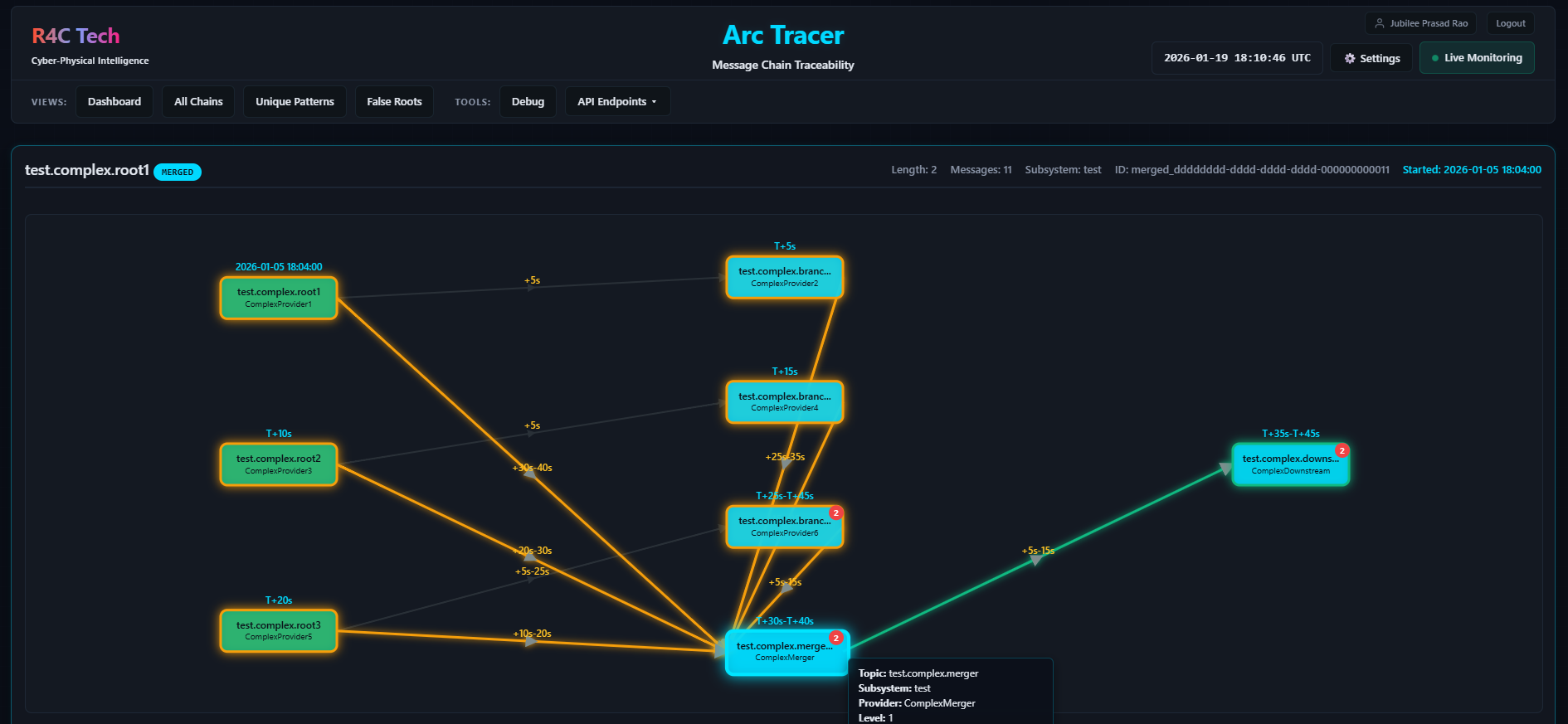
Arc Tracer showing end-to-end message chain tracing and data lineage visualization

Key Features

Complete Lineage

Trace any output back through every service that touched it, with full visibility into data transformations at each hop

Visual Diagrams

Audit-ready visual chain-of-custody diagrams suitable for integration status reviews, incident briefings, and regulatory submissions

Instant Lookup

Find any specific message and its full processing context in seconds using message IDs or event IDs

Gap Detection

Identify where upstream or downstream messages are missing or delayed using automated lag analysis

How Arc Tracer Works

1
Capture Relationships

Tracks message relationships using traceability headers and event IDs across all message topics and service boundaries

2
Build Chains

Constructs complete message chains from raw inputs through every processing stage to final outputs

3
Visualize Flow

Generates interactive visual diagrams showing data flow, transformation steps, and service dependencies

4
Analyze Gaps

Identifies missing links, processing delays, and bottlenecks anywhere in the chain

Use Cases

Incident Reviews and Post-Mortems

Reconstruct exactly what happened in your pipeline during an incident. Generate chain-of-custody diagrams that show every service, transformation, and timing decision, useful for defense program reviews and industrial failure analysis.

Compliance and Regulatory Audits

Prove data lineage and processing integrity to auditors and regulators. Applicable to government program compliance and any environment where demonstrable chain-of-custody is required.

Root Cause Debugging

When a bad output surfaces (a corrupted signal, a dropped transaction, or an anomalous sensor reading), trace backward through the full processing chain to pinpoint exactly where the error was introduced, without grepping logs across dozens of services.

Frequently Asked Questions

Arc Tracer uses traceability headers and event IDs embedded in messages to automatically construct message chains. Each service includes metadata about its upstream dependencies, which Arc Tracer assembles into complete lineage graphs spanning the entire processing topology, regardless of how many services or topics are involved.

Yes. Arc Tracer is validated in production environments processing high-volume real-time event streams. The chain store supports sub-second lookups across millions of archived messages, and the visualization engine renders large lineage graphs interactively without degradation.

Arc Tracer can still provide partial tracing using timestamps, message patterns, and content correlation for services that lack proper headers. It explicitly flags any gap in the chain where traceability metadata is absent, making it easy to identify which services need to be instrumented to achieve full lineage coverage.

Ready to Achieve Complete Data Lineage?

See how Arc Tracer can provide end-to-end traceability for your operations