L-WANE

Launch Weather Intelligence

Request Demo

ML-powered launch weather analysis and GO/NO-GO recommendations for space launch operations, from commercial pads to foreign site monitoring

Multi-Model ML Real-Time Predictions Multi-Site Monitoring

ML-Powered Launch Weather Analysis and GO/NO-GO Intelligence

Rocket launches are among the most weather-sensitive operations on earth. Forecast data is abundant, but translating it into a defensible GO/NO-GO call (against specific launch commit criteria, across multiple sites simultaneously, with explainability for supervisory review) requires analytical infrastructure most programs don't have. L-WANE solves that.

L-WANE ingests meteorological forecasts, runs them through calibrated ensemble ML models, applies configurable launch commit criteria, and delivers real-time GO/NO-GO recommendations with full prediction explainability. Whether the constraint is wind shear, precipitation probability, ceiling height, or a combination of launch-specific thresholds, L-WANE makes the logic explicit, auditable, and fast, validated against real go/no-go outcomes from operational launch programs.
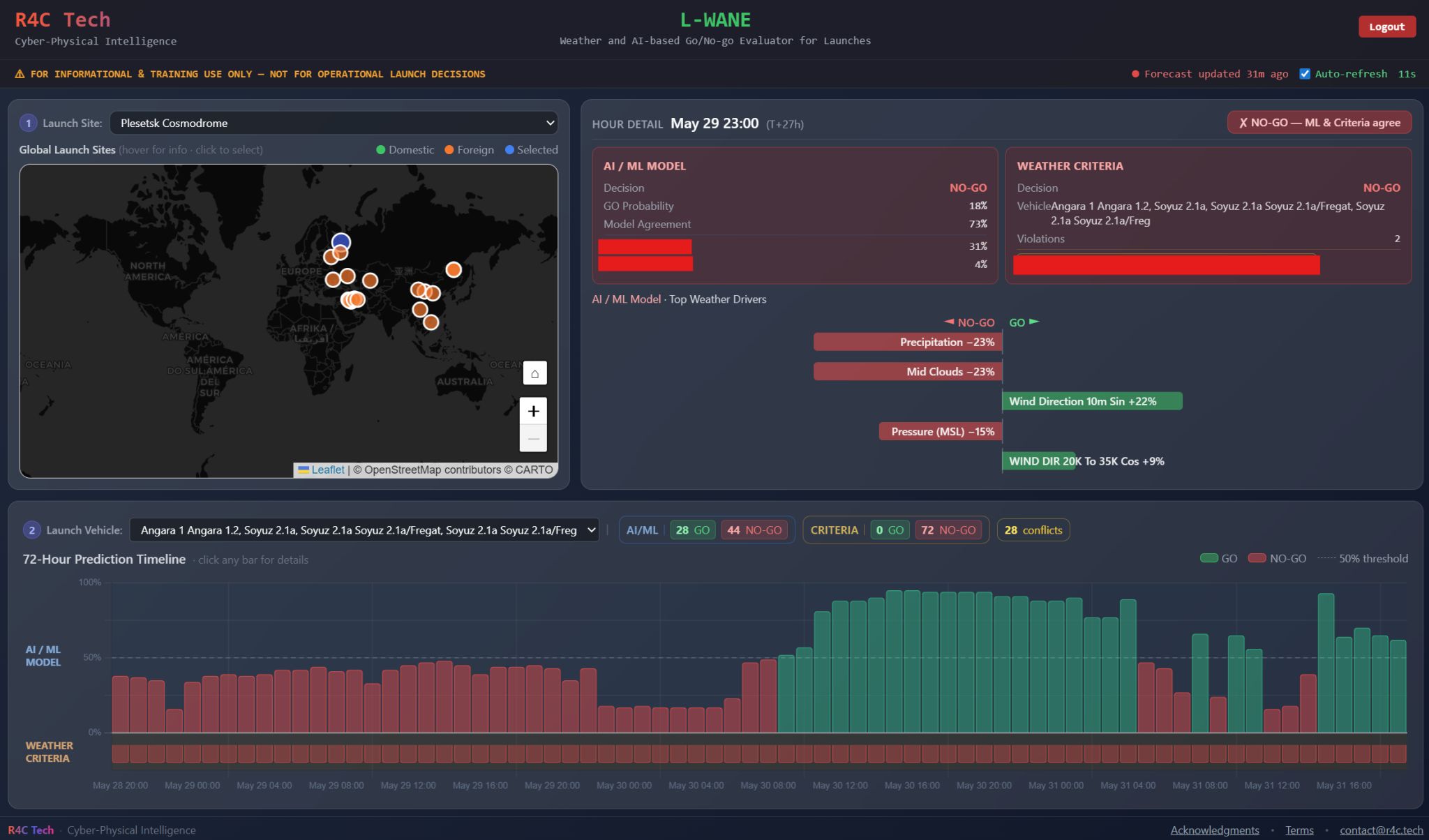
L-WANE dashboard showing launch weather GO/NO-GO analysis and multi-site monitoring

Key Features

Ensemble ML Models

Calibrated ensemble predictions validated against historical launch weather outcomes, combining multiple models for improved reliability

Configurable GO/NO-GO Logic

Thresholds for wind speed, precipitation probability, ceiling height, visibility, and other launch commit criteria, configurable per site

Weather Data Integration

Global weather forecast integration with hourly updates; architecture supports pluggable meteorological data providers

Prediction Explainability

Every recommendation shows which meteorological factors drove the decision, critical for operator trust, supervisory review, and post-event analysis

Multi-Site Monitoring

Simultaneous monitoring of multiple operational sites with independent criteria sets and unified dashboard comparison

Window Optimization

Identify optimal execution windows within 72-hour forecasts, useful for scheduling, resource allocation, and contingency planning

Event Streaming Integration

Real-time prediction publishing via event streaming for integration with downstream mission systems, dashboards, and alerting infrastructure

Live Dashboard

Interactive timeline visualization with site comparison, criteria tracking, and probability overlays for operator situational awareness

How L-WANE Works

1
Ingest Weather Data

Scheduled or event-driven ingest pulls meteorological forecasts from configured providers for each monitored site

2
ML Prediction

Calibrated ensemble models generate probability scores for each launch condition across the forecast horizon

3
Apply Criteria

Rule-based criteria engine validates ML outputs against operation-specific launch commit criteria, producing a structured GO/NO-GO recommendation

4
Publish & Visualize

Results published to the event stream and displayed on an interactive dashboard with factor-level explainability and multi-site comparison

Use Cases

Space Launch Operations

Real-time launch weather analysis and GO/NO-GO recommendations for commercial and government launch sites. Deployed in support of USSF Space Domain Awareness (SDA) TAP Lab operations, monitoring active launch sites and delivering ML-driven recommendations against configurable launch commit criteria.

Foreign Site Monitoring

Monitor weather conditions at foreign launch sites to characterize potential launch windows, turning publicly available meteorological data into predictive intelligence with ML-derived probability scores and factor-level explanations.

Extensible Framework

L-WANE's criteria engine and ML pipeline were built for launch but are domain-agnostic at the architecture level. Extension to other weather-constrained operations is achievable with appropriate training data and criteria definition. Contact us to discuss applicability to your use case.

Frequently Asked Questions

L-WANE uses calibrated ensemble models validated against historical operational outcomes. The system includes backtest harnesses that replay historical weather data against actual go/no-go decisions, so performance can be characterized and verified before live deployment.

L-WANE is purpose-built for launch weather today. The underlying ML pipeline and criteria engine are domain-agnostic, and the models can be retrained on domain-specific historical outcomes, making extension to other weather-constrained operations technically feasible. We are open to collaborating with programs that have the relevant training data and operational requirements to validate L-WANE in a new domain. Reach out to discuss your use case.

L-WANE decomposes each prediction to show which meteorological parameters drove the recommendation and by how much. An operator can see, for example, that a NO-GO call is driven primarily by a high probability of sustained winds exceeding threshold, not by a marginal combination of several factors. This transparency is critical for operator trust, supervisory override decisions, and post-event analysis or regulatory review.

Yes, the architecture uses pluggable forecast providers and can be adapted to ingest from standard meteorological feeds or internal sensor networks. The streaming pipeline supports blending multiple data sources for operations that combine model forecasts with local sensor telemetry.

Ready to Automate Your Launch Weather Analysis?

See how L-WANE can deliver ML-powered GO/NO-GO intelligence for your launch program.